Southwest Florida’s Go-to For Top-notch Marine Construction Services!
Southwest Florida’s Go-to For Top-notch Marine Construction Services!

Re-Decking 101: Transforming Your Old Dock Into a Like-New Space
A waterfront dock is constantly exposed to intense sunlight, rain, humidity, saltwater, foot traffic, and Florida’s tropical weather. Over time, even a well-built dock can develop faded, cracked, warped, or unsafe deck boards.
The good news is that an aging surface does not always mean the entire dock must be replaced. If the pilings, beams, joists, and other structural components remain in good condition, dock re-decking can restore the appearance, safety, and functionality of the structure.
Re-decking involves removing the old surface boards, inspecting the supporting structure, completing necessary repairs, and installing new decking. It can give an older dock a fresh appearance while preserving the usable foundation and framing.
This guide explains when to re-deck a dock, which materials work best in Florida, what the process involves, and when full replacement may be necessary.
What Is Dock Re-Decking?
Dock re-decking is the process of replacing the visible walking surface while keeping some or all of the existing supporting structure.
A re-decking project may include:
- Removing old deck boards
- Inspecting pilings, beams, and joists
- Replacing damaged framing components
- Correcting loose or corroded connections
- Installing new deck boards
- Updating fasteners
- Improving stairs or access points
- Adding lighting or other features
- Completing a final safety inspection
Re-decking is more substantial than replacing one or two damaged boards, but it is generally less extensive than demolishing and rebuilding an entire dock.
SeaBee General Contractor provides professional dock re-decking services in Marco Island and surrounding areas of Southwest Florida.
Signs Your Dock Needs Re-Decking
Dock damage often develops gradually. Property owners may become accustomed to the dock’s condition and overlook problems until the surface becomes uncomfortable or unsafe.
Watch for the following warning signs.
Cracked or Splintered Boards
Wood boards can crack and develop splinters after years of exposure to sun and moisture. Splinters create problems for people walking barefoot and can be especially concerning for children and pets.
Soft or Rotted Areas
Boards that feel soft, spongy, or unstable may have moisture damage or rot. These areas should be inspected promptly because the visible damage may extend below the surface.
Warping and Uneven Boards
Repeated wetting, drying, and heating can cause wood boards to warp, cup, or pull away from their fasteners. Uneven boards can create tripping hazards and allow additional moisture into the structure.
Loose or Corroded Fasteners
Saltwater and humidity can cause unsuitable metal fasteners to corrode. Loose screws, raised nail heads, and rusted connections may make the walking surface unsafe.
Significant Fading or Staining
Fading alone is usually cosmetic, but widespread discoloration, water stains, mold, or algae may indicate that the surface is retaining moisture or has not been properly maintained.
Frequent Board Repairs
Replacing individual boards may be practical when damage is limited. However, if new problems appear every season, re-decking the entire surface may provide better long-term value.
An Outdated Appearance
The dock may remain structurally sound but look worn or no longer complement the home. New decking can modernize the waterfront area without requiring complete reconstruction.
Re-Decking vs. Dock Repair
Dock repair and re-decking are related but different.
A basic repair normally addresses a limited problem, such as:
- One damaged board
- A loose cleat
- A broken step
- Several corroded fasteners
- Minor railing damage
Re-decking replaces most or all of the walking surface. It is appropriate when deterioration is widespread but the underlying structure remains serviceable.
A professional inspection should determine whether damage is limited to the surface or extends to the beams, joists, pilings, seawall connections, or boat lift.
Re-Decking vs. Complete Dock Replacement
Re-decking is not suitable for every old dock. Installing attractive new boards over a damaged foundation does not make the structure safe.
Complete replacement may be more appropriate when:
- Pilings are loose, leaning, or severely deteriorated
- Beams or joists have extensive rot
- The dock has major structural movement
- The layout no longer works for the vessel
- The boat lift requires substantial structural changes
- Storm damage affects the entire structure
- The dock does not meet current requirements
- Repairs would cost close to the price of replacement
- The owner wants to enlarge or significantly redesign the dock
If the structure remains stable and only the walking surface is worn, re-decking may be the more efficient option.
For a completely new layout, review SeaBee’s custom marine dock construction.
Best Materials for Dock Re-Decking in Florida
Material selection affects the appearance, maintenance, safety, cost, and long-term performance of the dock.
The two primary options are wood and composite decking.
Wood Dock Decking
Wood provides a traditional coastal appearance and may have a lower upfront cost.
Common benefits include:
- Natural grain and color
- Familiar installation method
- Wide availability
- Ability to stain or refinish
- Easier replacement of individual boards
- Lower initial material cost in many cases
However, wood is vulnerable to Florida’s moisture, sun, insects, and marine environment. Depending on the species and treatment, it may require regular cleaning, sealing, staining, sanding, and board replacement.
Potential problems include:
- Rot
- Splintering
- Warping
- Cracking
- Fading
- Insect damage
- Marine organism damage
- Corroded fasteners
Wood may be suitable for property owners who prefer an authentic natural surface and are prepared for ongoing maintenance.
Composite Dock Decking
Composite decking is popular for dock renovations because it resists many of the problems associated with natural wood.
Potential benefits include:
- Resistance to rot
- No wood-like splintering
- Low maintenance
- Consistent appearance
- Multiple colors and textures
- Resistance to fading and staining, depending on the product
- No routine sanding, staining, or sealing
- Long-term performance in suitable applications
Composite materials generally cost more upfront than pressure-treated wood. However, lower maintenance requirements may reduce expenses and labor over the life of the surface.
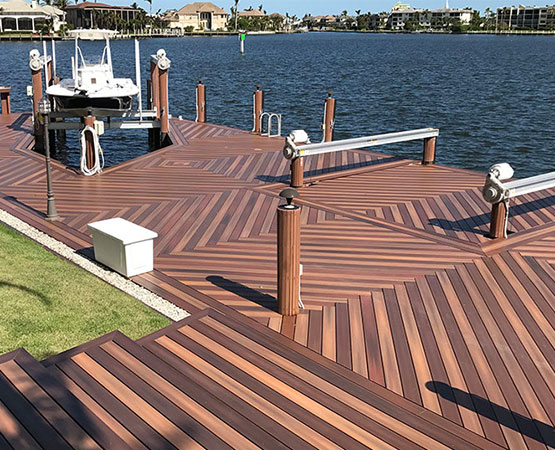
SeaBee General Contractor is an official Fiberon partner and installs Fiberon composite decking for suitable waterfront projects.
Read our guide comparing composite and wood dock decking before selecting a material.
Can Composite Decking Be Installed on an Old Dock?
Yes, but only when the existing structure can properly support the selected decking.
Before installing composite boards, the contractor should verify:
- Condition of the pilings
- Strength of the beams and joists
- Joist spacing
- Structural alignment
- Condition of connections
- Ventilation
- Drainage
- Manufacturer installation requirements
- Fastener compatibility
- Existing electrical systems
- Boat lift connections
Composite products may require different joist spacing from the original wood boards. Additional framing may be necessary to prevent movement or sagging.
The contractor should also account for the expansion and contraction of composite materials as temperatures change.
How the Dock Re-Decking Process Works
A professional project generally follows several stages.
1. Dock Inspection
The contractor evaluates the entire dock, not only the visible boards.
The inspection should include:
- Pilings
- Beams
- Joists
- Bracing
- Connections
- Fasteners
- Stairs and ladders
- Railings
- Electrical components
- Boat lift connections
- Seawall connections
This determines whether re-decking is appropriate and identifies repairs that should be included in the proposal.
2. Material Selection
The property owner chooses between wood, composite, PVC, or another approved decking product.
Important considerations include:
- Budget
- Maintenance preferences
- Color
- Surface texture
- Heat retention
- Slip resistance
- Product warranty
- Dock exposure
- Availability
- Manufacturer requirements
Samples should be viewed outdoors in direct sunlight and shade before making the final selection.
3. Removal of Existing Decking
The old boards and fasteners are carefully removed. This provides a clearer view of the supporting structure and may reveal damage that was hidden from above.
4. Structural Repairs
Damaged joists, blocking, connections, or other components are repaired or replaced before the new surface is installed.
If significant structural deterioration is discovered, the contractor should explain how it affects the scope and price before proceeding with additional work.
5. Framing Preparation
The framing may need to be:
- Cleaned
- Leveled
- Reinforced
- Re-spaced
- Repaired
- Treated where appropriate
- Modified for the selected fastener system
Correct preparation helps the decking remain stable and drain properly.
6. New Decking Installation
The new boards are installed according to the product requirements. Proper board spacing, end gaps, fasteners, ventilation, and alignment are important for appearance and long-term performance.
7. Final Inspection and Cleanup
The contractor reviews the completed surface, removes debris, checks fasteners and transitions, and confirms that the dock is ready for use.
How Much Does Dock Re-Decking Cost in Florida?
There is no single price for re-decking because every dock has a different size, layout, condition, and level of access.
The total cost may depend on:
- Dock square footage
- Wood, composite, or PVC material
- Product collection and color
- Condition of the framing
- Number of structural repairs
- Removal and disposal of old boards
- Fastener system
- Stairs, ladders, and railings
- Boat lift connections
- Electrical work
- Construction access
- Permit requirements
- Additional design features
Composite decking usually has a higher initial material cost than pressure-treated wood. The long-term comparison should also include staining, sealing, sanding, repairs, and future board replacement.
An on-site inspection is the most reliable way to receive an accurate re-decking estimate.
Does Dock Re-Decking Require a Permit?
Permit requirements depend on the location and scope of work.
Replacing surface boards may be treated differently from work involving:
- Structural framing
- Pilings
- Dock expansion
- Layout changes
- Boat lift installation
- Electrical systems
- Seawall connections
- Major storm repairs
Even when the footprint remains unchanged, structural modifications may require local approval.
Property owners should confirm the requirements before demolition begins. Never assume that work is permit-free because the dock already exists.
Can You Change the Dock Layout During Re-Decking?
Minor surface changes may be possible, but enlarging or redesigning the dock can turn a re-decking project into a larger reconstruction project.
Changes that may require additional planning or permits include:
- Increasing dock dimensions
- Adding a lower platform
- Moving stairs
- Installing a boat lift
- Adding new pilings
- Changing the dock footprint
- Extending farther into the water
- Adding electricity or water
- Building seating or storage areas
If the current layout no longer fits the boat or lifestyle, compare the cost of modifying the old structure with designing a new dock.
Can a Boat Lift Be Added During Re-Decking?
Re-decking can be a convenient time to evaluate a new or existing boat lift, but the lift must be planned according to the vessel and dock structure.
The contractor should consider:
- Fully loaded vessel weight
- Boat length and beam
- Hull configuration
- Water depth
- Piling locations
- Dock layout
- Electrical requirements
- Required lift capacity
- Future vessel upgrades
Adding a lift may require new structural work and permits.
SeaBee installs boat lifts for different vessel types and waterfront conditions.
Dock Re-Decking Design Ideas
New decking can improve more than the condition of the surface. It can update the entire waterfront space.
Possible upgrades include:
- Modern composite colors
- Contrasting picture-frame borders
- Wider walking areas
- Integrated lighting
- Improved stairs
- Safer ladders
- Updated railings
- Hidden fasteners
- Seating areas
- Fish-cleaning stations
- Water connections
- Storage
- Improved access around the boat lift
Any structural, electrical, or dimensional changes should be included in the project plans from the beginning.
Explore SeaBee’s available decking products and colors.
How to Maintain a Re-Decked Dock
Even low-maintenance decking needs routine care.
Composite Decking Maintenance
- Remove leaves and debris
- Rinse away salt and dirt
- Clean spills promptly
- Use manufacturer-approved cleaning products
- Avoid harsh chemicals
- Follow pressure-washing limitations
- Keep gaps between boards clear
- Inspect fasteners and framing regularly
Wood Decking Maintenance
- Clean the surface regularly
- Check for splinters and cracks
- Replace damaged boards
- Inspect fasteners
- Apply appropriate stain or sealer
- Address algae and mold
- Check for rot
- Follow treatment recommendations for the wood species
The entire dock should also be inspected after major storms or unusual water conditions.
When Is the Best Time to Re-Deck a Dock?
Florida docks can be renovated throughout much of the year, but scheduling may be affected by:
- Rain
- Tropical weather
- Material availability
- Permit timing
- Contractor schedule
- Water access
- Tides
- Seasonal property use
Do not wait until the surface becomes unsafe. Planning the project early provides more time to compare materials, obtain approvals, and schedule construction.
Why Choose SeaBee General Contractor?
SeaBee General Contractor has served Southwest Florida since 1997 and specializes in marine construction for waterfront properties.
Our services include:
- Dock re-decking
- Dock repairs
- Custom dock construction
- Composite decking installation
- Boat lifts
- Seawalls
- Rip rap and shoreline solutions
SeaBee operates under Florida Certified General Contractor License CGC 1536998 and is an official Fiberon partner.
View examples of our completed marine construction projects.
Transform Your Old Dock
An old, weathered dock does not always need to be demolished. If its supporting structure remains sound, re-decking can restore its appearance, improve safety, reduce maintenance, and extend its useful life.
The first step is a complete inspection. Once the structural condition is known, you can compare wood and composite materials and choose a design that fits your property and waterfront lifestyle.
SeaBee General Contractor provides dock re-decking services in Marco Island and surrounding Southwest Florida communities.
Contact SeaBee General Contractor to request a dock inspection and project estimate.
Call (239) 642-0116.
Frequently Asked Questions
What does dock re-decking include?
Re-decking generally includes removing old boards, inspecting the supporting structure, completing necessary repairs, preparing the framing, and installing new decking.
Is it cheaper to re-deck or replace a dock?
Re-decking is usually less expensive when the pilings and framing remain structurally sound. Complete replacement may offer better value when the underlying structure has extensive damage.
What is the best material for re-decking a Florida dock?
Composite decking is a popular low-maintenance choice because it resists rot and splintering. Wood may be preferred for its natural appearance and lower initial cost.
Can you put composite decking over old wood boards?
The old surface boards should generally be removed so the supporting structure can be inspected. New composite decking should be installed directly on suitable, properly spaced framing.
How long does dock re-decking take?
The timeline depends on dock size, material, structural repairs, access, permits, and weather. A contractor can provide an estimate after inspecting the dock.
Does SeaBee provide dock re-decking in Marco Island?
Yes. SeaBee General Contractor provides dock re-decking, repairs, new dock construction, and composite decking installation in Marco Island and surrounding Southwest Florida communities.