Southwest Florida’s Go-to For Top-notch Marine Construction Services!
Southwest Florida’s Go-to For Top-notch Marine Construction Services!

How to Choose the Best Dock Design for Your Waterfront Property in Marco Island
Owning a waterfront property in Marco Island gives you direct access to some of Southwest Florida’s best boating and coastal experiences. However, getting the most from your property requires a dock designed for your shoreline, vessel, water conditions, and lifestyle.
A well-designed dock should provide convenient water access, protect your boat, withstand Florida’s coastal environment, and complement the appearance of your home. Choosing the right design involves much more than deciding how the finished dock should look.
Before building or replacing a dock, consider its intended use, size, layout, decking material, boat lift, water depth, shoreline conditions, permitting requirements, and long-term maintenance.
This guide explains how to choose the best dock design for your waterfront property in Marco Island.
Start With How You Plan to Use the Dock
The best dock design begins with a clear understanding of how you intend to use it.
Some homeowners need a simple platform for boarding a boat. Others want a larger waterfront space for fishing, relaxing, entertaining, launching kayaks, or accessing multiple vessels.
Consider whether your dock will be used for:
- Securing and boarding a boat
- Installing a boat lift
- Storing personal watercraft
- Fishing
- Swimming or entering the water
- Launching kayaks and paddleboards
- Outdoor seating and entertaining
- Cleaning and maintaining a vessel
- Providing access for family members and guests
Your dock should have enough space for its primary purposes without creating unnecessary construction or interfering with navigation.
SeaBee General Contractor creates custom marine docks based on each waterfront property’s conditions and the owner’s needs.
Consider the Size and Type of Your Boat
If you own a boat, its dimensions and weight will influence almost every part of the dock design.
Your marine contractor should know:
- Boat length and beam
- Fully loaded vessel weight
- Hull type
- Draft
- Motor configuration
- Location of cleats and boarding points
- Whether you plan to purchase a larger boat
- Type and capacity of the required lift
The dock must provide enough clearance for safe entry, docking, boarding, and maintenance. Designing only for your current boat may create limitations if you plan to upgrade your vessel in the future.
If a boat lift will be part of the project, it should be planned with the dock rather than added as an afterthought. SeaBee installs several types of boat lifts, including piling lifts, yacht lifts, high-speed lifts, and PWC or skiff lifts.
Evaluate the Waterfront Conditions
Every Marco Island waterfront property has different conditions. A design that works for one property may not be suitable for another property nearby.
A professional site evaluation should consider:
- Water depth
- Tidal changes
- Canal or open-water exposure
- Wave action
- Boat traffic
- Soil conditions
- Shoreline stability
- Existing seawall condition
- Property boundaries
- Nearby docks
- Access for construction equipment
Water depth is especially important. The dock and lift must be positioned where the boat can safely approach and operate without contacting the bottom.
The contractor must also consider how tides and water movement may affect the structure over time.
Choose Between a Fixed and Floating Dock
One of the main design decisions is whether to install a fixed dock, a floating dock, or a combination of both.
Fixed Docks
Fixed docks are supported by pilings driven into the ground beneath the water. The deck remains at a consistent height while the water level changes.
Potential advantages include:
- Stable walking surface
- Durable construction
- Easy integration with boat lifts
- Customizable size and layout
- Suitable for many residential waterfront properties
However, the height must be carefully selected based on tides, vessel access, and local conditions.
Floating Docks
Floating docks rise and fall with the water level. They may provide convenient boarding because the distance between the deck and water remains more consistent.
Potential benefits include:
- Adjustment to changing water levels
- Convenient access for kayaks and personal watercraft
- Flexible configurations
- Lower boarding height
Floating systems may not be appropriate for every property. Exposure, currents, waves, anchoring requirements, and local regulations must be evaluated first.
In some cases, a fixed dock with a smaller floating platform provides the most practical combination.
Select the Right Dock Layout
Dock layout should support vessel access while using the available waterfront space efficiently.
Common residential dock layouts include:
Straight Dock
A straight dock extends from the shoreline or runs parallel to it. It offers a simple, efficient design for properties with limited space.
L-Shaped Dock
An L-shaped dock provides additional surface area at the end or side of the main walkway. It can create more room for boarding, fishing, or seating.
T-Shaped Dock
A T-shaped dock offers a wider platform at the end. This layout may provide access to multiple sides of a boat or additional space for waterfront activities.
Wraparound Dock
A wraparound dock provides access along more than one side of the vessel. It can make boarding, cleaning, maintenance, and loading supplies easier.
Multi-Level Dock
A multi-level design can include a lower platform for kayaks, paddleboards, swimming, or easier water access. The levels must be planned carefully for safety and changing water conditions.
The final layout must account for property setbacks, neighboring structures, navigation space, and local permitting requirements.
Choose Dock Materials for Florida’s Coastal Climate
Marco Island’s sun, humidity, saltwater, rain, and storms can be hard on marine structures. Material selection affects the dock’s appearance, safety, maintenance requirements, and long-term cost.
Pressure-Treated Wood
Wood provides a traditional waterfront appearance and may have a lower initial cost.
However, it can require regular maintenance and may eventually experience:
- Splintering
- Warping
- Cracking
- Fading
- Rot
- Damage from moisture and marine conditions
Composite Decking
Composite decking is a popular choice for homeowners looking for durability and lower maintenance.
Potential advantages include:
- Resistance to rot and splintering
- Lower maintenance requirements
- Consistent appearance
- Multiple color and finish options
- Comfortable surface for regular waterfront use
- Long-term performance in coastal environments
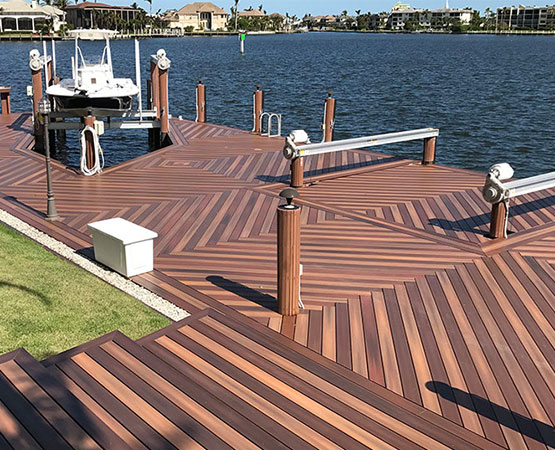
SeaBee General Contractor is an official Fiberon partner and uses Fiberon composite decking for custom waterfront projects.
PVC Decking
PVC decking is another low-maintenance option that resists moisture and decay. Product quality, heat exposure, surface texture, color, and installation requirements should be considered when selecting a specific decking system.
Your contractor can help you compare wood, composite, and PVC based on your budget, desired appearance, and maintenance expectations.
Include the Boat Lift in the Original Design
A boat lift protects the vessel by keeping it out of the water when it is not being used. This can help reduce exposure to algae, marine growth, corrosion, and changing water conditions.
The lift must match:
- Vessel weight
- Boat length and beam
- Hull configuration
- Motor placement
- Water depth
- Dock layout
- Piling location
- Required lifting speed
- Electrical requirements
Choosing a lift based only on the boat’s dry weight can be a mistake. Fuel, equipment, water, batteries, accessories, and future upgrades may increase the total load.
Planning the dock and lift together creates a more functional layout and can prevent expensive modifications later.
Think About Safety and Accessibility
A dock should be safe and comfortable for everyone who uses it.
Depending on the property and intended use, helpful features may include:
- Non-slip decking
- Adequate lighting
- Handrails
- Stable stairs or ladders
- Cleats placed away from main walking paths
- Gates for children or pets
- Wider walkways
- Lower platforms for water access
- Electrical and water connections
- Proper drainage
- Adequate space around the boat lift
If older adults, children, or people with limited mobility will regularly use the dock, accessibility should be included in the initial design.
Plan for Electricity, Water, and Lighting
Modern docks often include more than a deck and pilings. Planning utilities early can help keep the design functional and organized.
Possible additions include:
- Shore power
- Water connections
- Fish-cleaning stations
- Dock lighting
- Underwater lighting
- Boat lift controls
- Electrical outlets
- Security cameras
All electrical systems near the water must be installed correctly and comply with applicable safety and building requirements.
Consider the Existing Seawall
A dock and seawall work together as parts of the waterfront property. If the seawall is leaning, cracked, losing soil, or structurally unstable, it should be inspected before the dock design is finalized.
Building a new dock next to a failing seawall may complicate future repairs or replacement.
SeaBee provides custom seawall solutions designed for Marco Island’s coastal environment. Coordinating seawall and dock work can help create a more complete long-term plan for the property.
Design for Storms and Coastal Exposure
No dock can be completely protected from severe weather, but appropriate materials, connections, pilings, and construction methods can improve resilience.
A dock built in Marco Island should account for:
- Strong winds
- Heavy rain
- Wave action
- Storm surge
- Saltwater exposure
- Floating debris
- Changing tides
- Repeated sun exposure
The dock should also be inspected after hurricanes and tropical storms. Loose boards, damaged connections, shifted pilings, and electrical issues should be repaired before the structure is used again.
Understand Permits and Local Requirements
Marine construction in Florida may require approvals from local, county, state, or environmental authorities. Requirements can vary depending on the location, dock dimensions, waterway, protected resources, and scope of work.
The permitting process may address:
- Dock length and width
- Property setbacks
- Navigational access
- Water depth
- Environmental impact
- Piling placement
- Boat lift installation
- Electrical work
- Seawall connections
Never assume that an existing dock means a replacement can be built in exactly the same configuration. Regulations and site conditions may have changed since the original structure was installed.
Working with a licensed marine contractor familiar with Marco Island and Collier County can make the planning and permitting process easier.
Establish a Realistic Budget
The cost of a dock depends on much more than its length.
Important pricing factors include:
- Dock size and layout
- Number and type of pilings
- Decking material
- Boat lift type and capacity
- Water depth
- Soil conditions
- Site accessibility
- Existing structure removal
- Electrical and plumbing work
- Railings, ladders, lighting, and other accessories
- Engineering and permitting requirements
When comparing estimates, review what each proposal includes. A lower quote may exclude important items such as demolition, permits, engineering, electrical work, or boat lift installation.
Choose a Licensed Local Marine Contractor
Waterfront construction requires specialized experience. A qualified contractor should understand local waterways, coastal materials, permitting requirements, boat lift systems, and the conditions affecting Marco Island properties.
Before selecting a contractor:
- Verify the contractor’s license
- Ask about insurance
- Review completed dock projects
- Request a detailed written proposal
- Confirm which materials will be used
- Discuss permits and engineering
- Ask how changes and additional costs are handled
- Review the estimated project schedule
SeaBee General Contractor has served Southwest Florida since 1997 and operates under Florida Certified General Contractor License CGC 1536998.
You can view examples of our completed marine construction projects before planning your dock.
Build a Dock Designed for Your Marco Island Property
The best dock design is not simply the largest or most expensive option. It is the design that fits your waterfront, vessel, lifestyle, and long-term plans.
A successful dock project combines:
- A functional layout
- Proper vessel clearance
- Suitable materials
- A correctly sized boat lift
- Safe access
- Coastal durability
- Compliance with local requirements
- A design that complements the property
SeaBee General Contractor designs and builds custom docks for homeowners in Marco Island and surrounding Southwest Florida communities.
Contact SeaBee General Contractor to schedule a site assessment and discuss your waterfront project.
Call us at (239) 642-0116.
Frequently Asked Questions
What is the best dock material for Marco Island?
Composite and PVC decking are popular because they resist moisture, rot, and splintering while requiring less maintenance than traditional wood. The best material depends on the property, budget, appearance, and intended use.
Should I choose a fixed or floating dock?
Fixed docks provide a stable surface and work well with many boat lift systems. Floating docks move with the water level and may provide easier access to kayaks or personal watercraft. A contractor should evaluate the waterfront conditions before recommending either option.
Can I add a boat lift to my dock?
Yes, but the lift must match the boat’s fully loaded weight, dimensions, hull, water depth, dock layout, and piling configuration. It is best to include the lift during the original dock design process.
Do I need a permit for a dock in Marco Island?
Most new docks, replacements, extensions, and boat lift installations require permits or approvals. Requirements depend on the property and scope of work.
How long does it take to build a dock?
The timeline depends on design, permits, engineering, materials, weather, site conditions, and project complexity. Your contractor can provide a more accurate schedule after evaluating the property.
Can SeaBee replace an existing dock?
Yes. SeaBee provides new dock construction, dock repairs, and professional re-decking services for waterfront properties.