Southwest Florida’s Go-to For Top-notch Marine Construction Services!

Best Dock Decking Material for Florida: Composite vs. Wood
Choosing the right decking is one of the most important decisions when building or renovating a dock in Florida. Deck boards are constantly exposed to intense sunlight, high humidity, heavy rain, saltwater, foot traffic, and tropical weather.
Traditional wood offers a natural appearance and lower initial cost, while composite decking provides lower maintenance and resistance to many common problems associated with waterfront environments.
So, which option is better for a dock in Marco Island, Naples, or Southwest Florida?
For many waterfront property owners, composite dock decking provides the best balance of durability, appearance, safety, and maintenance. However, the right choice depends on the property, budget, product, dock structure, and owner’s preferences.
This guide compares composite and wood dock decking to help you choose the right material for your waterfront property.
What Is Composite Dock Decking?
Composite decking is an engineered product commonly made from a combination of recycled or synthetic materials and wood fibers. Some products include protective surface layers designed to resist moisture, staining, fading, and everyday wear.
Composite decking is available in different:
- Colors
- Board profiles
- Surface textures
- Grain patterns
- Widths
- Product collections
- Performance levels
- Warranty terms
Not every composite board is approved or appropriate for marine use. The selected product must be suitable for the dock’s design, joist spacing, exposure, fastening system, and installation conditions.
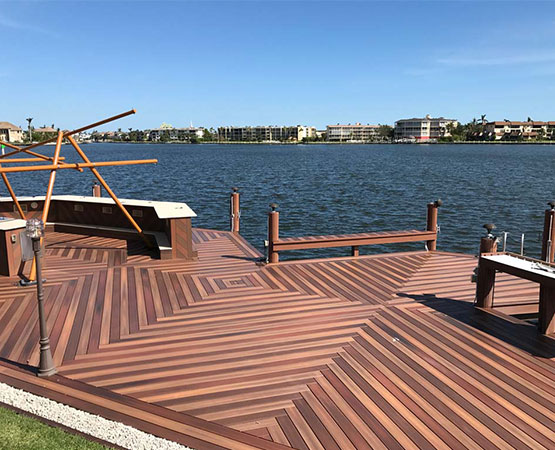
SeaBee General Contractor installs Fiberon composite decking for custom waterfront projects in Southwest Florida.
Composite vs. Wood Dock Decking
| Feature | Composite decking | Wood decking |
|---|---|---|
| Maintenance | Lower maintenance | Requires more frequent care |
| Rot resistance | Does not rot like natural wood | Can decay with moisture exposure |
| Splinters | Does not splinter like wood | May splinter as it ages |
| Insects and marine organisms | Resistant to many common forms of damage | Can be vulnerable depending on species and treatment |
| Appearance | Consistent colors and wood-look finishes | Authentic natural grain |
| Initial cost | Usually higher | Often lower |
| Long-term cost | May require fewer maintenance expenses | Staining, sealing, repairs, and replacement can add cost |
| Heat | Some colors can become hot | Temperature varies by species and finish |
| Fading | Designed for improved fade resistance | Can weather and change color |
| Board replacement | Product and color matching may be difficult later | Replacement wood is often widely available |
| Sustainability | Some products use recycled content | Depends on sourcing and treatment |
Both materials can work for Florida docks when correctly selected and installed. The differences become more significant over years of exposure to water and weather.
1. Composite Decking Resists Rot and Moisture Damage
Water is one of the biggest challenges for traditional wood docks. Repeated wetting and drying can contribute to:
- Rot
- Warping
- Splitting
- Cracking
- Fastener movement
- Soft or weakened boards
- Surface deterioration
Composite decking does not rot in the same way as natural wood. This makes it attractive for docks exposed to humidity, rain, spray, and frequent foot traffic from the water.
However, composite decking still requires proper installation. Adequate spacing, ventilation, drainage, framing, and manufacturer-approved fasteners help the surface perform as intended.
2. Composite Requires Less Maintenance
Wood decking may require periodic:
- Cleaning
- Sanding
- Staining
- Sealing
- Painting
- Fastener replacement
- Board repair or replacement
Composite decking does not typically require sanding, staining, or painting. Routine care usually involves removing dirt, leaves, pollen, salt residue, and organic material according to the manufacturer’s cleaning instructions.
This can be a major advantage for property owners who want to spend more time enjoying the waterfront and less time maintaining the dock.
Can You Pressure-Wash Composite Decking?
Some composite products may allow limited pressure washing, but excessive pressure or holding the nozzle too close can damage the surface.
Before using a pressure washer:
- Check the manufacturer’s instructions
- Use the recommended pressure
- Select an appropriate nozzle
- Maintain the correct distance
- Test a small area first
- Avoid directing concentrated pressure into joints
In many cases, mild soap, water, a soft-bristle brush, and a garden hose are sufficient.
3. Composite Decking Does Not Splinter Like Wood
Older wood boards may develop splinters, cracks, or rough edges. These can be uncomfortable for people walking barefoot and may create concerns for children and pets.
Composite decking does not splinter in the same way as natural wood. This can make it a comfortable choice for:
- Barefoot use
- Families with children
- Pet owners
- Swimming access
- Waterfront seating areas
- High-traffic walkways
The surface should still be inspected for loose fasteners, damage, algae, and debris that could create a tripping or slipping hazard.
4. Composite Can Provide Better Long-Term Appearance
Wood naturally changes as it is exposed to sunlight and moisture. Depending on the species and maintenance, it may fade, turn gray, stain, crack, or develop uneven coloring.
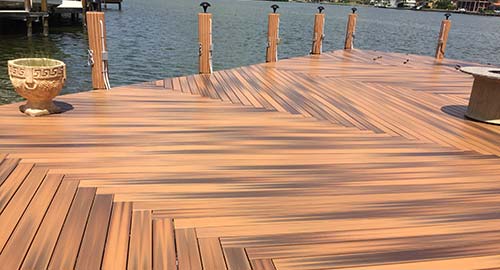
Composite decking is manufactured to provide more consistent color and texture. Modern products can imitate the grain and tonal variation of natural wood while avoiding many of its maintenance requirements.
Available styles range from traditional brown wood tones to modern gray and coastal colors.
Explore SeaBee’s available decking products and color options.
5. Composite Is Resistant to Insects and Marine Organisms
Wood used near the water may be vulnerable to insects, fungi, rot, or marine organisms depending on the material, treatment, and exposure.
Composite decking is not a natural food source in the same way as untreated wood and resists many common forms of biological deterioration.
The underlying dock structure must still be inspected. Using composite surface boards does not protect wood framing, pilings, fasteners, or other structural components from deterioration.
6. Composite Decking Can Offer Long-Term Value
Composite decking generally costs more upfront than common pressure-treated wood. However, the purchase price is only one part of the long-term cost.
Wood may require ongoing expenses for:
- Stain
- Sealer
- Paint
- Cleaning products
- Sanding
- Labor
- Repairs
- Replacement boards
Composite eliminates many of these maintenance tasks. Over time, the reduced need for refinishing and board replacement may offset part of the higher initial cost.
Actual value depends on the selected product, installation quality, maintenance, exposure, and how long the owner plans to keep the property.
7. Some Composite Products Use Recycled Materials
Many composite decking products incorporate recycled plastic or reclaimed wood content. This can reduce the need for some virgin raw materials and provide a productive use for recovered material.
Environmental considerations should include more than recycled content. Property owners may also want to review:
- Product lifespan
- Manufacturer practices
- Transportation
- Maintenance products
- Replacement frequency
- End-of-life options
SeaBee works with Fiberon, which offers multiple composite and PVC decking collections for residential and waterfront applications.
8. Composite Decking Offers More Design Options
Composite decking is available in a range of colors, textures, board profiles, and price levels.
Property owners may select decking that complements:
- Home exterior
- Seawall
- Boat lift
- Outdoor furniture
- Pool area
- Landscaping
- Waterfront surroundings
Color selection should consider both appearance and practical performance. Darker boards may absorb more heat in direct sunlight, while lighter coastal shades may remain more comfortable and show less fading or salt residue.
Before choosing a product, view actual samples outdoors at different times of day. Computer screens and printed brochures may not show the exact color.
Is Composite Decking Slippery When Wet?
Any dock surface can become slippery when covered with water, algae, sunscreen, leaves, dirt, or marine residue.
Many composite products include textured surfaces designed to provide traction. However, slip resistance differs by product, and no material remains completely slip-proof under all conditions.
To improve safety:
- Select a product appropriate for wet environments
- Keep the surface clean
- Remove algae and organic buildup
- Maintain proper drainage
- Repair loose or damaged boards
- Use adequate lighting
- Follow manufacturer maintenance instructions
A heavily embossed texture may provide additional grip, but it may also hold more dirt. Product samples can help the owner compare surfaces before ordering.
Does Composite Decking Get Hot in Florida?
Composite decking can become hot in direct Florida sunlight. The temperature depends on:
- Board color
- Surface finish
- Product composition
- Sun exposure
- Air temperature
- Shade
- Ventilation
- Time of day
Dark boards generally absorb more heat than lighter colors. For docks used frequently by barefoot residents, children, or pets, lighter shades may provide greater comfort.
Shade structures and thoughtful material selection can also help manage surface temperature.
How Long Does Composite Dock Decking Last?
High-quality composite decking can provide many years of use when it is properly installed and maintained.
Actual service life depends on:
- Product quality
- Installation
- Joist spacing
- Ventilation
- Fastening system
- Sun and water exposure
- Cleaning practices
- Storm damage
- Structural movement
- Manufacturer specifications
Some manufacturers offer long residential warranties for staining, fading, or material performance. Warranty terms vary by product and application, so owners should review the current written warranty before purchasing.
The decking boards may outlast portions of the underlying framing. The complete dock should still receive regular professional inspections.
Is Wood Ever Better for a Florida Dock?
Wood remains a practical option for some waterfront properties.
Property owners may prefer wood because it offers:
- Authentic natural appearance
- Familiar construction method
- Lower initial cost
- Easy availability
- Ability to sand or refinish the surface
- Straightforward replacement of individual boards
Certain hardwoods may offer good marine performance but can be expensive and require careful sourcing. Pressure-treated lumber is more affordable but generally requires more maintenance.
Wood may be the right choice when natural appearance and lower upfront cost are higher priorities than reduced maintenance.
Potential Disadvantages of Composite Dock Decking
Composite decking has significant benefits, but it is important to understand the limitations.
Higher Initial Cost
Composite typically costs more upfront than pressure-treated wood.
Heat Retention
Some products, especially dark colors, may become hot in direct sunlight.
Thermal Expansion and Contraction
Composite boards can expand and contract as temperatures change. Correct spacing and fastening are essential.
Product-Specific Installation
Different manufacturers have specific requirements for joist spacing, ventilation, board orientation, fasteners, and clearances.
Difficult Color Matching
If a board needs replacement many years later, the original color or collection may no longer be available. New boards may also look different beside weathered boards.
Structural Limitations
Composite decking is a walking surface, not automatically a replacement for structural framing. The existing joists and supports must be inspected before re-decking.
Can You Install Composite Decking on an Existing Dock?
Yes, composite boards can often be installed on an existing dock if the underlying structure remains safe and suitable.
Before re-decking, the contractor should inspect:
- Pilings
- Beams
- Joists
- Connections
- Fasteners
- Framing spacing
- Signs of rot
- Structural movement
- Seawall connections
- Boat lift connections
- Electrical systems
Installing new composite boards over damaged framing does not correct structural problems.
SeaBee provides dock re-decking services for waterfront properties where the existing structure can support a new surface.
Best Composite Decking Colors for Florida Docks
Color is both a design and comfort decision.
Popular options include:
- Light gray
- Coastal gray
- Weathered wood
- Light brown
- Natural oak tones
- Tan
- Driftwood-inspired finishes
Light and medium shades are often practical for sunny Florida docks because they may absorb less heat than very dark colors. They can also complement coastal homes, boats, seawalls, and outdoor furniture.
Owners should compare samples in direct sunlight and shade before making a final selection.
Why SeaBee Uses Fiberon Composite Decking
SeaBee General Contractor is an official Fiberon partner. Fiberon offers composite and PVC decking collections in multiple colors, surface styles, and performance levels.
Potential Fiberon benefits vary by collection but may include:
- Resistance to rot and splintering
- Low maintenance
- Wood-inspired appearance
- Fade and stain protection
- Multiple color options
- Manufacturer warranty coverage
Product availability, specifications, approved applications, and warranty terms should be confirmed for each project.
Learn more about Fiberon decking options available through SeaBee.
How to Choose the Right Dock Decking
Before selecting wood or composite, ask:
- Is the product approved for the planned application?
- How much direct sunlight does the dock receive?
- Will people regularly walk barefoot?
- How much maintenance am I willing to perform?
- Is the existing structure suitable for new decking?
- What joist spacing does the product require?
- Which fasteners should be used?
- What is included in the manufacturer’s warranty?
- How will the boards respond to heat and moisture?
- Will the color complement the home and waterfront?
- Can matching replacement boards be obtained later?
- What is the total installation cost?
A professional inspection and detailed proposal can help owners compare the complete cost and performance of each option.
Composite Decking for New Dock Construction
Planning composite decking at the beginning of a new dock project allows the framing, joist spacing, fasteners, layout, and drainage to be designed around the selected product.
The project can also coordinate:
- Boat lift placement
- Electrical connections
- Water access
- Dock lighting
- Seating areas
- Stairs and ladders
- Personal watercraft platforms
- Storage
- Seawall connections
SeaBee designs custom marine docks based on the property, vessel, waterfront conditions, and owner’s intended use.
Upgrade Your Southwest Florida Dock
Composite decking can be an excellent choice for Florida waterfront properties because it resists rot and splintering, requires less maintenance than wood, and offers a wide range of colors and finishes.
However, successful performance depends on selecting the right product and installing it according to the manufacturer’s requirements.
SeaBee General Contractor has served Southwest Florida since 1997 and provides:
- Custom dock construction
- Composite dock decking
- Dock re-decking
- Dock repairs
- Boat lift installation
- Seawalls
- Rip rap and shoreline solutions
View examples of our completed marine construction projects.
If you are planning a new dock or replacing old wood decking in Marco Island or Southwest Florida, contact SeaBee General Contractor to discuss your project.
Call (239) 642-0116.
Frequently Asked Questions
Is composite decking good for docks in Florida?
Yes. A high-quality composite product approved for the application can resist rot, splintering, moisture, and many common maintenance problems associated with wood docks.
Is composite decking better than wood for a dock?
Composite is often better for owners who prioritize low maintenance, rot resistance, and consistent appearance. Wood may be better for those who prefer a natural surface and lower initial cost.
Does composite dock decking get hot?
It can become hot in direct sunlight. Lighter colors generally absorb less heat than very dark boards, although performance varies by product.
Is composite decking slippery when wet?
Any dock can become slippery when wet or covered with algae and debris. Choose a textured product intended for wet environments and keep the surface clean.
Can composite decking be installed over an old dock?
It can be installed when the existing pilings, beams, joists, connections, and framing remain structurally suitable. The dock should be inspected before re-decking.
Does composite decking need to be sealed?
Composite decking generally does not require the regular staining and sealing associated with wood. Owners should follow the manufacturer’s cleaning and maintenance instructions.
Does SeaBee install Fiberon dock decking?
Yes. SeaBee General Contractor is an official Fiberon partner and installs Fiberon decking for suitable new dock and re-decking projects.